
How to Rebuild Core Strength Safely
- bhupiluhi
- Jun 9
- 6 min read
If your core feels weak after an injury, pregnancy, back pain, or a long stretch of inactivity, forcing your way through planks and sit-ups usually makes things worse. When people ask how to rebuild core strength, the real answer is not about pushing harder. It is about restoring coordination, breathing, and control so your body can handle daily movement without strain.
A strong core is not just visible abdominal muscle. It is a working system that includes the deep abdominals, back muscles, diaphragm, pelvic floor, and hips. These areas support your spine, transfer force through your body, and help you bend, lift, walk, and exercise with less discomfort. When that system is not doing its job well, the body often compensates elsewhere, which can show up as low back pain, pelvic pressure, poor balance, or a feeling that your body is not as stable as it used to be.
What rebuilding core strength actually means
Rebuilding is different from building for the first time. If you are recovering from surgery, dealing with chronic pain, returning after childbirth, or trying to move better after an accident or workplace injury, your body may need retraining before it needs resistance.
That matters because weakness is not always the only issue. Sometimes the problem is timing. Your core muscles may turn on too late, grip too hard, or stop coordinating well with your breathing. In those cases, adding harder exercises too soon can reinforce the wrong pattern instead of improving function.
This is why some people do lots of ab work and still feel unstable. The issue is not effort. It is that the right muscles are not contributing in the right way at the right time.
Common signs your core needs rehab, not just exercise
Core weakness does not look the same for everyone. For one person, it may feel like back pain after standing for 20 minutes. For another, it may be leaking with exercise, abdominal doming, or a sense of heaviness through the pelvis. Some people notice they hold their breath when lifting groceries or getting out of bed. Others feel their neck, hip flexors, or lower back doing most of the work during simple exercises.
These are useful clues. They suggest your body may benefit from a more guided progression rather than generic fitness advice.
How to rebuild core strength in the right order
Most successful rehab follows a progression. You do not need to stay at the easiest level forever, but skipping ahead can delay recovery.
Start with breathing and pressure control
Your diaphragm, deep abdominals, and pelvic floor work together. If breathing is shallow or constantly held, pressure tends to push downward or outward instead of being managed well through the trunk.
A simple starting point is diaphragmatic breathing in a comfortable position, such as lying on your back with knees bent or resting on your side. As you inhale, allow your rib cage to expand. As you exhale, think about gently drawing in through the lower abdominal wall without bracing hard. The goal is subtle control, not a forceful squeeze.
This step can feel almost too easy, but it lays the groundwork for everything that follows. If breathing and pressure are poorly managed, harder core exercises often become compensation exercises.
Add low-load activation
Once you can breathe well and create light abdominal tension, the next step is teaching the trunk to stay steady during small movements. This may include heel slides, bent-knee fallouts, marching, or supported bridge variations.
These exercises are not about fatigue. They are about maintaining alignment and control while the arms or legs move. If your back arches, your ribs flare, or you feel strain in the neck and hips, the exercise may be too advanced for where you are right now.
That is not failure. It is useful information.
Build endurance before intensity
Your core needs to work for long periods during everyday life. It supports you while sitting, walking, lifting, and carrying. Because of that, endurance often matters more than max effort.
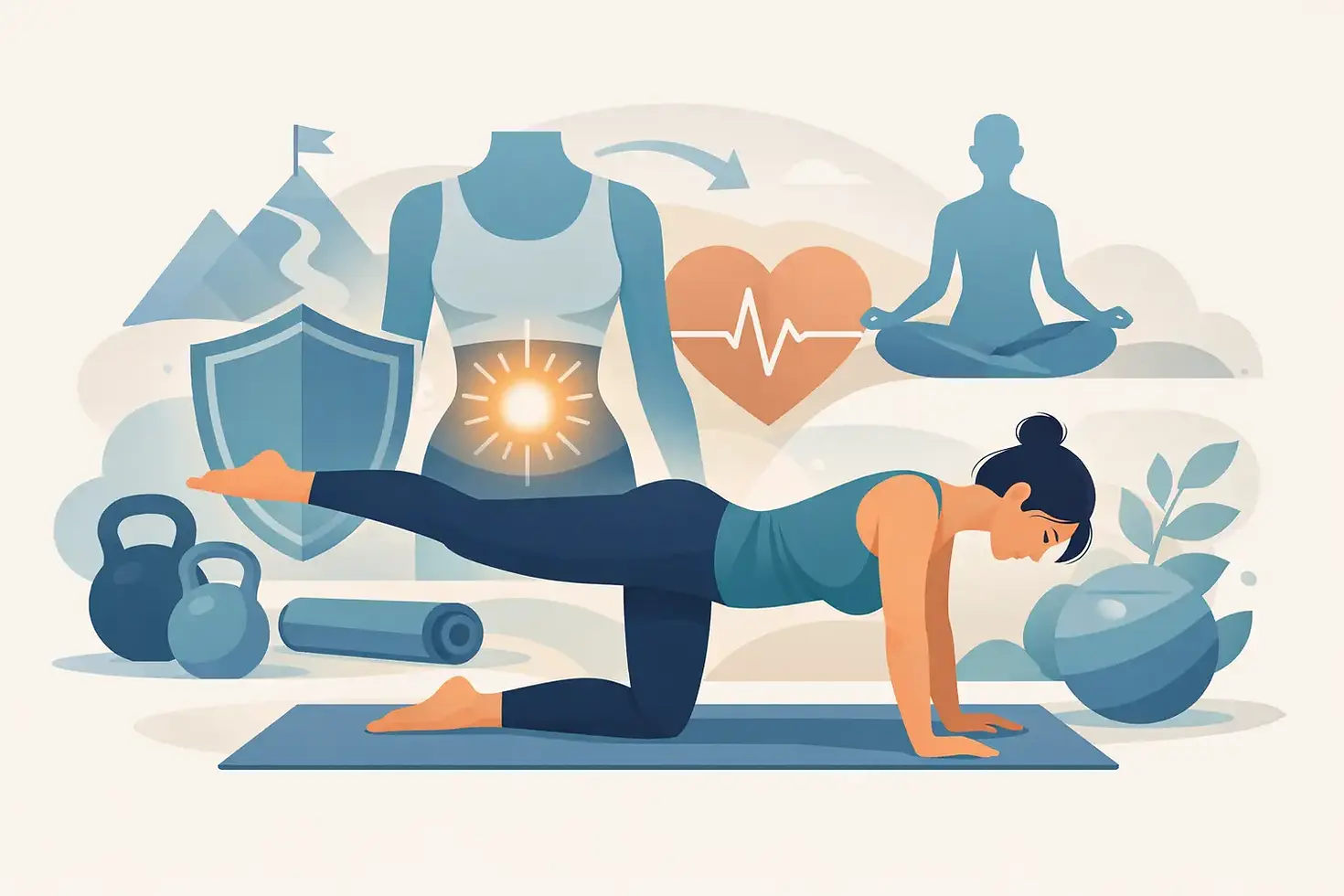
This is where many people get stuck. They try to rebuild strength with a few hard exercises but do not have the control to repeat them well. A better approach is shorter sets, cleaner form, and steady progression. Dead bugs, bird dogs, side-lying work, and modified planks can all fit here, depending on your condition and starting point.
Progress into functional movement
Once you can control your trunk in basic positions, the next step is applying that control to real movement. Squats, carries, step-ups, resistance band work, and controlled rotation patterns often become more relevant than floor-based ab exercises.
This is where rehab starts to feel practical. You are no longer just working the core in isolation. You are training it to support tasks that matter - getting up from the floor, lifting a child, returning to work duties, or getting back to sport.
Why generic core programs can backfire
Online workouts often assume your body is ready for volume, impact, and repeated spinal flexion. That may be fine for some people. It is not ideal for everyone.
If you have low back pain, a disc-related issue, pelvic floor symptoms, abdominal separation, or are recovering after surgery, certain exercises may aggravate symptoms even if they are commonly called core work. Sit-ups, leg lowers, long planks, and twisting movements are not automatically bad, but they are not automatically appropriate either.
The trade-off is simple. Doing more advanced exercises may feel productive in the short term, but if your body compensates through pain, breath-holding, or poor mechanics, you can end up delaying recovery. The right exercise is the one your body can perform well enough to build from.
It depends on why your core became weak
There is no single answer to how to rebuild core strength because the cause changes the plan.
After pregnancy, the focus may include pelvic floor coordination, pressure management, and gradual return to load. After a back injury, reducing protective tension and restoring spinal support may come first. After abdominal surgery, pacing and tissue healing matter. If you have been inactive due to chronic pain, tolerance and confidence may be just as important as muscle recruitment.
This is where individual assessment matters. Two people can both feel weak, but the best treatment approach may be very different.
When to get professional help
If you have pain that persists, symptoms that spread down the leg, pelvic heaviness, leaking, visible abdominal bulging, dizziness with exertion, or repeated setbacks when trying to exercise, it is worth getting assessed. A physiotherapist can identify whether the issue is true weakness, poor movement strategy, limited mobility, or another factor that is placing extra demand on the core.
At Sterling Physiotherapy and Wellness, this kind of rehab is approached as more than a list of exercises. The goal is to understand the root cause of your symptoms, then build a plan that restores strength and function in a way that fits your body and your daily life.
What progress should feel like
Progress is not always dramatic at first. Often it shows up as less pain after chores, better posture without forcing it, easier walking, or more confidence lifting and reaching. You may notice your breathing feels less restricted, your balance improves, or your back does not tighten up as quickly.
Those changes matter. They tell you the system is becoming more efficient.
You should also expect some adjustment along the way. A little muscle fatigue is normal. Sharp pain, increasing pelvic pressure, worsening symptoms, or feeling less stable after exercise are signs your plan may need to be modified.
A smarter way to think about core strength
Core rehab is not about getting the hardest workout. It is about creating a body that can manage load well. That means your spine feels supported, your breathing stays steady, and your trunk responds appropriately when life asks you to move.
For some people, rebuilding happens quickly. For others, especially after pain or injury, it takes patience. That is normal. Recovery is rarely linear, but with the right progression, it becomes much more predictable.
If your core does not feel strong right now, that does not mean you have to live with instability or keep guessing your way through exercises. Start where control returns, not where frustration begins. That is usually where real recovery takes hold.


Comments